The Oshki Monastery—a masterpiece of 10th-century Georgian architecture in Turkey
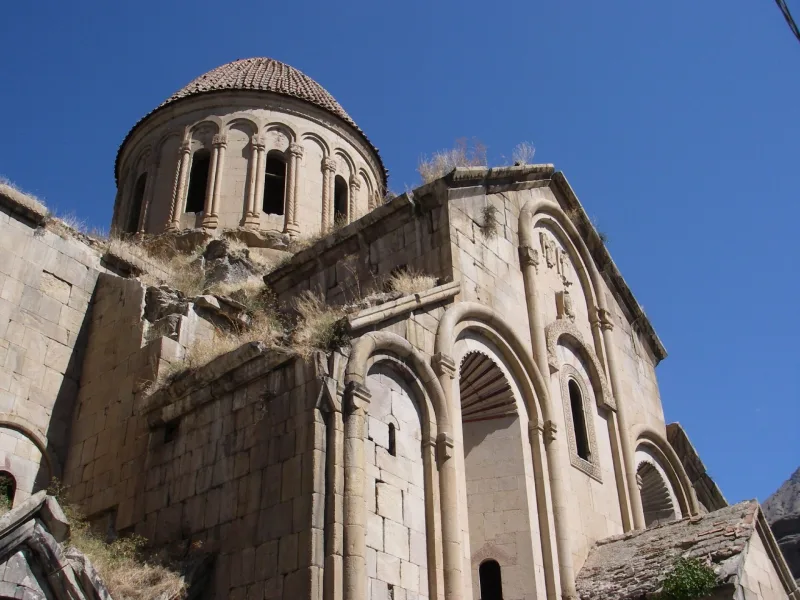
The Oshki Monastery (Georgian: ოშки, Turkish: Oşki Manastırı) is one of the most magnificent monuments of medieval Georgian architecture, built in the second half of the 10th century in the historic region of Tao, within the territory of the present-day province of Erzurum. The complex’s main church, dedicated to St. John the Baptist, is considered the largest domed church of the Bagratid era and one of the key landmarks of Christian architecture in the Caucasus. Despite its remoteness, partial preservation, and access difficulties, Oshki attracts pilgrims, researchers, and enthusiasts of Byzantine-Georgian architecture every year. It is a place where one can sense the scale of the political ambitions and spiritual quests of the Georgian rulers of the early Middle Ages.
History and Origins
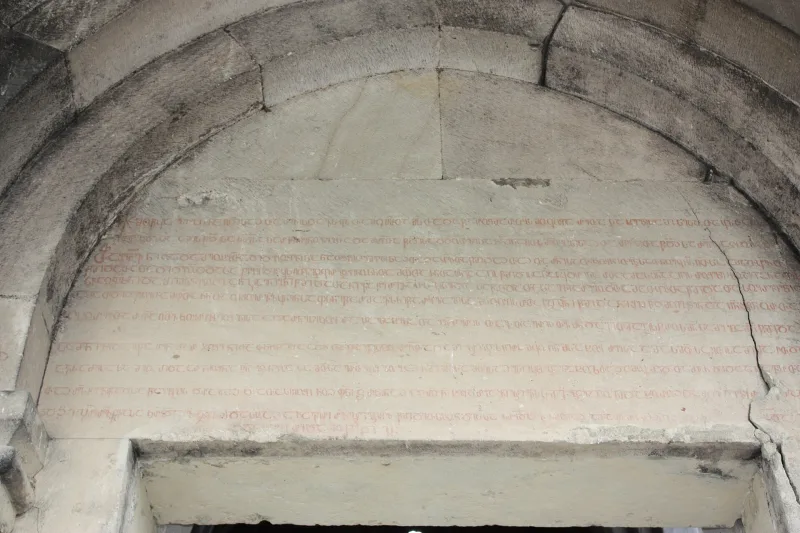
The Oshki Monastery was founded between 963 and 973 on the initiative of two prominent members of the Bagrationi dynasty—David III Kuropalates and Bagrat, the Eristav of Eristavs. These political figures not only achieved the actual unification of Georgian lands but also actively patronized church construction. Oshki became the main monument of their joint program and the largest construction project of the era. According to epigraphic inscriptions preserved on the southern facade of the church, the work took ten years and involved the finest craftsmen of the time.
The monastery’s heyday fell during the 10th–12th centuries, when Oshki served not only as a religious but also as an educational center: it operated its own school for scribes, translated patristic literature from Greek into Georgian, and compiled collections of hymns. Many prominent figures of the Georgian Church emerged from the walls of Oshki, including the translator and theologian John Grdzelisdzé. The monastery’s connections extended as far as Mount Athos, Jerusalem, and Constantinople—it was a laboratory of medieval Georgian thought.
Following the Mongol invasion of the 13th century and the gradual loss of Tao by the Byzantine-Georgian world, the monastery fell into decline. After the Ottoman Empire conquered these lands in the 16th century, Oshki became an ordinary village, and the main church was turned into a quarry for local residents. Nevertheless, thanks to the exceptional quality of its construction, the main structure of the building has survived to this day. Since the 19th century, the monastery has attracted the attention of Georgian and European researchers: Dmitri Bakradze, Ekvtime Takaishvili, and later Vakhtang Beridze and other art historians left detailed descriptions, measurements, and photographs. In the 20th century, the building was used alternately as a mosque and a hayloft, which caused significant damage to the unique frescoes.
Architecture and What to See
The main church of Oshki is a monumental domed structure with a “free cross” plan inscribed within a rectangle. It is approximately 41 meters long, 35 meters wide, and about 32 meters high from the floor to the base of the dome. In terms of size and ambition, Oshki is comparable to the largest Byzantine and Armenian churches of the same period. The walls are built of carefully hewn blocks of yellow-pink sandstone, which gives the building a warm, almost golden hue in the sunset light. The dodecagonal dome drum rests on four massive pillars, between which systems of sub-dome arches and ribs were once arranged.
Stone Carvings on the Facades
The main ornament of Oshki is the carved decoration of the facades. On the south wall, above the central portal, is a famous relief composition: two figures—David Kuropalat and Bagrat Eristav of Eristavs—raise a model of the temple toward the sky, where an image of an archangel with outstretched wings hovers. This composition symbolizes the ascension of an earthly gift to the Creator and simultaneously commemorates the political and spiritual union of the donors. Below, along the perimeter of the facades, are carved crosses, grapevines, lions, griffins, and Georgian inscriptions in Asomtavruli script.
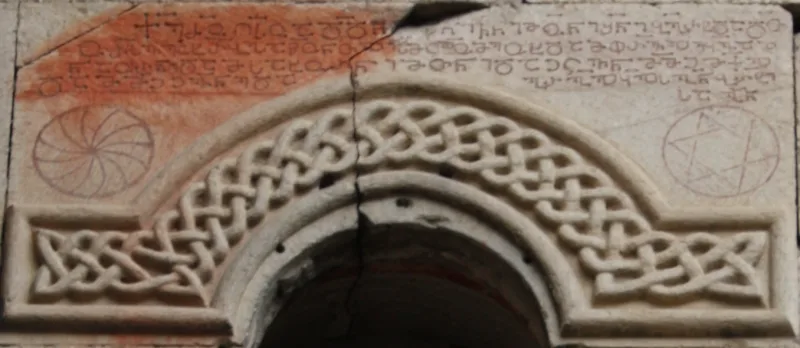
Special attention should be paid to the “bordzgali” bas-relief—an ancient Georgian solar symbol—next to the six-pointed star. This is a rare example of the coexistence of archaic and Christian symbolism on a single facade. The relief is known in the literature as “Bordzgali and the Star of David in Oshki” and has become one of the monument’s most recognizable symbols. It is frequently photographed and reproduced in books on Georgian art.
Interior and Frescoes
Inside, the church impresses with its vast space, covered by vaults, and a high altar apse with a triple window. The 10th–11th-century frescoes that once covered the walls have been partially preserved in the apse and on the pilasters: these depict scenes of the Deesis, the Communion of the Apostles, the Evangelists, and figures of saints. However, they are in poor condition: during the Soviet era, hay was stored here, which caused the plaster to dry out and the paint layer to flake off. Despite this, the skill of the artists—the light folds of the garments, the expressive faces, and the subtle tonal transitions—remains impressive to this day.
Colonnade and Narthex
Adjacent to the south side of the church is a colonnade-narthex unique to Georgian architecture: seven arches on carved columns with capitals in the form of stylized leaves and crosses. This colonnade was built later than the main structure (probably in the 11th century) and served as the main entrance, as well as a resting place for pilgrims. Today, only a few arches remain, but they still make a strong impression, especially with the contrast of light and shadow at midday.
Interesting Facts and Legends
- At the time of its construction, the main church of Oshki was the largest domed building in Georgia and one of the largest in the Caucasus.
- Epigraphic inscriptions on the temple walls allow for the precise dating of its construction and the identification of the names of the donors and craftsmen—a rare luxury for medieval monuments.
- Manuscripts were copied in Oshki that are now preserved at the Institute of Manuscripts in Tbilisi, on Mount Athos, and in Jerusalem.
- In the 1980s, Turkish authorities permitted rare Orthodox prayer services to be held here with the participation of a Georgian delegation.
- The bordzgali—a solar symbol—on the wall of Oshki is sometimes compared to the modern coat of arms of Georgia.
- At the end of the 19th century, one of the temple’s columns was transported to Tbilisi and installed in the courtyard of the Georgian National Museum.
- Oshki served as a model for the architects of later Georgian churches, including Svetitskhoveli in Mtskheta.
How to get there
The Oshki Monastery is located in the village of Chamlyamach (formerly known as Oshketi) in the Uzundere district of Erzurum Province. It is about 110 kilometers from Erzurum and about 90 kilometers from Artvin. The most convenient way is to rent a car in Erzurum or Trabzon. Part of the route winds through the picturesque mountain serpentines of the Tortum River valley, passing by the famous Tortum Waterfall. The one-way trip takes about 2.5 hours; the road is generally in good condition, with paved surfaces extending all the way to the village.
Visiting is possible without a car, but it requires patience: infrequent buses run from Erzurum to the village of Uzundere, from where you can hire a taxi. Many travelers combine a visit to Oshki with a trip to other sites in Tao-Klarjeti: Khakhuli, Ishkhani, Otkhta-Eklisia, and Parkhali. It’s convenient to fit a visit to Oshki and Khakhuli into a single day, as they are located in neighboring valleys.
Tips for travelers
The best time to visit is late spring (May–June) and fall (September–October). In summer, the valley is hot, and the sun is very bright when viewing the facades; in winter, the road may be closed due to snow. Bring water, a hat, comfortable shoes, a flashlight for exploring the dark interior areas, and a wide-angle lens for photography—it’s difficult to capture the entire temple in a single frame due to the village’s dense buildings.
Respect the locals: the villagers are fond of the monument, but loud behavior and careless handling of the frescoes are unacceptable. Do not leave trash on the temple grounds, do not lean backpacks against the painted plaster, and do not climb onto the altar steps. If you are interested in Georgian church architecture, it is worth reading the monographs by Vakhtang Beridze or Anton Chkhvaishvili’s guidebook “Tao-Klarjeti” in advance.
Combining a visit to Oshki with other Georgian monasteries in the region—Kakheuli, Ishkhani, Otkhta-Eklisia, Parkhali, and Doliskana—provides a comprehensive picture of the architectural genius of medieval Georgia. The itinerary can be extended to 3–4 days with overnight stays in Artvin, Yusufeli, or Yayla. The Oshki Monastery is not merely a tourist attraction but a living museum of medieval Georgian architecture, and each visit offers a fresh perspective on this phenomenon.
Current Condition and Protective Status
The Oshki Monastery is included in the list of Turkey’s cultural heritage sites and is protected by the state, although actual conservation measures remain limited. In the 2010s, with the support of the Georgian government and the Tao-Klarjeti Foundation, work began on the conservation of the frescoes and the stabilization of the masonry. The condition of the dome is of particular concern: cracks have formed at the top, through which water enters the interior during heavy rains. Nevertheless, thanks to the quality of the original construction, the church has stood for over a thousand years—an impressive testament to the talent of 10th-century Georgian craftsmen.
The Georgian Orthodox Church and the Georgian government regularly raise the issue of recognizing Oshki and other monuments in Tao-Klarjeti as UNESCO World Heritage Sites. Although this initiative has not yet received formal support, the discussion regarding international protection continues. Thousands of tourists and pilgrims sign petitions in support of the monuments every year, which gradually increases their visibility in the public sphere. Every visitor contributes to this protection simply by taking an interest in the site—your visit and a photo on social media help keep Oshki alive in the collective memory.
The Founders of Oshki and the Political Context
It is impossible to understand Oshki without understanding the political context. David III Kuropalates (c. 945–1000) was one of the most influential rulers of medieval Georgia. His services to Byzantium—in particular, his assistance in suppressing the rebellion of Varda Skleros—were rewarded with the title of kuropalates and significant land holdings. Using these resources, David III implemented an ambitious program to build large churches, which were intended to demonstrate simultaneously his piety, political power, and the cultural identity of Tao. Oshki became the most prominent manifestation of this program. Khakhuli, Ishkhani, and a number of smaller churches were built alongside it.
The joint participation of the two ktitors—David and Bagrat—reflects a rare example of collegial patronage. On the southern façade of Oshki, they are depicted as equal participants in the scene. This is a rarity in medieval art, where typically only one ktitor is depicted. This iconographic choice emphasized that the monastery belonged not to a single individual, but to the entire Bagrationi dynasty as a symbol of Georgian unity. Historians view this as an important step toward the future political unification of the Georgian principalities in the early 11th century under the rule of Bagrat III.
Oshki in Art History Literature
The study of Oshki began in the second half of the 19th century with the expeditions of Dmitri Bakradze (1873) and Nikodim Kondakov. The first comprehensive description of the monument was published by Ekvtime Takaishvili in the early 20th century: his monograph “Archaeological Expeditions to the Southern Provinces of Georgia” contains measurements, drawings, and photographs, many of which remain the sole evidence of lost details. During the Soviet period, research was continued by Vakhtang Beridze, Revaz Mepishashvili, and Vakhtang Tsintsadze, placing Oshki within the broader panorama of Georgian architectural history. They demonstrated that Oshki had a significant influence on the further development of domed architecture—from Svetitskhoveli in Mtskheta to Alaverdi in Kakheti.
In the 21st century, new studies by Turkish and Western scholars emerged—including works by Antoine Einatyan, Annegret Plontke-Lunning, and Michael Haa. They clarified the chronology of the construction phases, examined comparative parallels with Armenian and Byzantine examples, and conducted a stylistic analysis of the sculptural decoration. Today, Oshki is viewed not as an isolated monument, but as part of a broad medieval Caucasian architectural family in which Georgian, Armenian, and Byzantine traditions mutually enrich one another. It is precisely this that makes Oshki such a valuable cultural phenomenon and a must-see stop on any serious itinerary through Eastern Anatolia.